
In front of. The creative process is becoming deeper and more complex, because the designer is now working not only with tools but also with algorithms.
Generative models and large language models have significantly changed the design workflow. They are able to generate layouts, offer colour palettes, create interface templates, and even help with the selection of typography. Sometimes a short text query is enough. A number of interface alternatives show up after a short while, each of which can serve as the foundation for additional prototyping.
This transformation has also accelerated the use of pre-built visual resources such as graphic design templates and ready-made illustration libraries. Designers no longer need to build every element from scratch. Instead, they can start with structured foundations and refine them creatively.
That is why the generation of ideas has become much faster. Wireframes are created almost instantly. Layouts appear by the dozens. The designer gets not just one solution but a whole field of possibilities for creative iteration.
Automating Tasks and Speeding Up Prototyping
Task automation remains one of the main advantages of artificial intelligence in design. Routine operations no longer take up hours of work. Resizing of elements, adaptive design for different devices, and reuse of components are performed automatically.
This changes the very structure of the work. Instead of lengthy manual editing, the designer focuses on user experience and strategic design. It analyses user scenarios, checks the convenience of the interface, and tests various design solutions.
Generative models allow you to quickly create visual elements, images, and texts. Large language models analyse huge amounts of data and find patterns in the design structure. Due to this, algorithms can offer unexpected solutions for interfaces.
Similar technologies are already actively used in marketing. According to research, 76% of marketers use generative artificial intelligence to create content. This confirms how quickly automation penetrates into creative processes.
Another important shift involves the growing popularity of reusable design assets. Libraries of graphic design templates allow designers to assemble complex layouts quickly while maintaining visual consistency across projects.

Design Systems and Modular Interface Structure
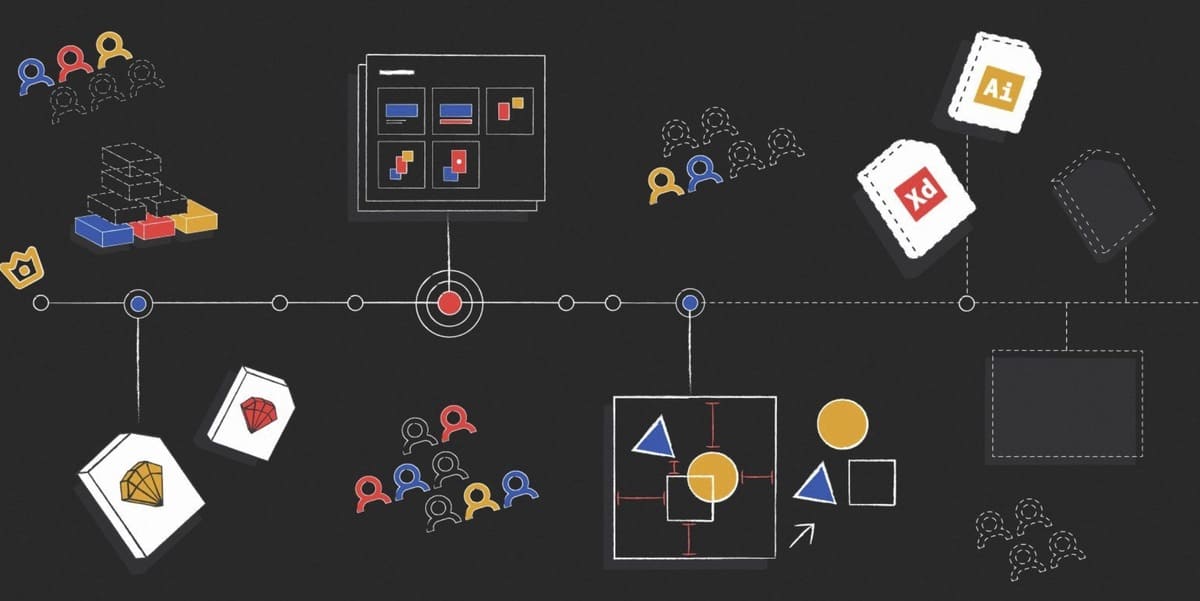
Design systems have become another important part of modern design processes. They include modular components, reusable elements, and interface templates. This structure allows you to significantly speed up the development of projects.
Modular components form unified design standards. Each interface element – a button, form, card, or menu – is created once and then used in many projects. This ensures visual consistency and makes it easier to scale the product.
At the same time, the rise of reusable assets has expanded the role of specialised visual resources such as 3D SVG designs, which allow designers to integrate dimensional illustrations into interfaces without heavy rendering workloads. These assets provide depth and visual interest while remaining lightweight and flexible for digital environments.
However, design systems do not only affect the speed of development. They lower the barrier of entry into the profession. People without deep visual design skills can use ready-made templates and create working interface layouts.
That is why they are increasingly talking about the democratisation of design. But with accessibility comes a new problem. Design quality management is becoming more important than ever.
The Evolution of the Designer’s Role
The proliferation of generative models is gradually changing the profession of a designer. Previously, the specialist created each element manually. Today, many visual solutions are generated automatically.
But that doesn’t make the designer any less important. Rather the opposite. His role becomes strategic.
The algorithms are capable of generating dozens of layout options. However, it is the individual who chooses which solutions meet the objectives of the product and the expectations of users. It analyses the emotional design, evaluates the brand’s storytelling, and validates the user experience.
A new model of interaction is emerging – a person in a loop. Artificial intelligence generates the initial result. The person analyses it, corrects the style and makes the final decision.
Thus, the designer performs several functions at once. He becomes a strategic prompter, creative director, and quality supervisor.
Architectural Visualization and 3D Rendering
Artificial intelligence technologies are also actively used in architecture. This is especially noticeable in the field of 3D rendering and photorealistic visualisation.
Modern rendering systems allow you to create complex digital models of buildings and spaces. With GPU computing and real-time rendering, architects can instantly check lighting, materials, and spatial composition.
Serious equipment is required to work on such projects. A video card with at least 8 GB of VRAM, as well as 32 GB of RAM, is usually used. When working with large scenes, 64 GB of RAM is recommended.
Interest in such technologies is growing very fast. The home visualisation market is expected to reach $2.04 billion in 2025. Moreover, 70% of architectural firms plan to invest in rendering tools.
There is a simple reason for this. Photorealistic visualisation allows clients to better understand the project even before construction begins.
Physical Models and Hybrid Design
Despite the rise of digital technology, physical architectural models remain an important part of design. They help architects see the shape of a building, feel the proportions of space, and study the behaviour of light.
Modern architectural models are often created using digital fabrication. 3D printing, laser cutting, and robotic manufacturing make it possible to create models with high precision.
Materials are also becoming more diverse. Resins, photopolymers, acrylics, and eco-friendly materials are used.
The hybrid approach is particularly interesting. It combines physical modelling and digital visualisation. This method allows you to test architectural ideas faster.
Research shows that using hybrid design methods can reduce the number of edits in a project by up to 25%. In addition, the project approval process is accelerated by about 30%.
Physical models also help clients understand the project better. In some cases, the level of understanding of an architectural concept increases by about 40%.
Generative Content and Scalable Marketing
Generative models are also actively used in marketing strategies. They allow you to create scalable content and automate the production of advertising materials.
Artificial intelligence is capable of generating dozens of ad variants, texts, and images. This makes A/B testing significantly faster. Marketers can check different versions of campaigns and choose the most effective ones.
The development of generative technologies is also reflected in the industry’s economy. The generative artificial intelligence market in the creative industries is projected to grow from $3.08 billion in 2024 to $12.61 billion in 2029. This corresponds to an average annual growth of about 32.5%.
In addition, automation can significantly reduce costs. In some cases, the production of media content can become cheaper by about 10%, and general production processes can reduce costs by up to 30%.
Digital Asset Management and System Integration
As the volume of content increases, a new challenge arises. It is necessary to manage digital assets effectively.
Media content management systems allow you to store images, videos, and documents in a single structure. Intelligent labelling helps to classify files automatically and speeds up the search for materials.
Platform integration also plays an important role. When design tools, content management systems, and analytics services work together, the workflow becomes significantly more efficient.
Ethical Issues and Quality Control
However, the development of artificial intelligence brings not only advantages. Algorithms can generate content, but they are not always able to assess its meaning or relevance to the context.
Therefore, the issues of ethics of artificial intelligence are becoming more and more relevant. Intellectual property, data management, and algorithm transparency must be taken into account.
Quality control remains a human task. It is the designer who checks the result of the algorithm and ensures that the content matches the brand.
A New Balance Between Human and Algorithm
Artificial intelligence is not a substitute for designers. It changes the structure of their work.
Algorithms perform content generation and automation of repetitive tasks. The person focuses on the strategy, user experience, and creative direction of the project.
Modern design is gradually turning into a collaboration between a human and an algorithm. Generative models accelerate creative iteration. Design systems ensure scalability of interfaces. Hybrid methods combine physical models and digital visualisation.
It is in this combination that a new type of creative process appears. Faster. More flexible. And significantly more scalable.

I write about how sites, digital tools and work processes affect real work. I am interested not in trends for trends’ sake, but in clear solutions that make the digital environment more convenient, more stable and more useful.