Until a few years ago, many organisations perceived cloud infrastructure as an almost universal solution. It was assumed that migrating all systems to public cloud services would automatically provide scalability, simplified infrastructure management, and lower costs. The reality turned out to be more complicated. By 2026, companies began to analyse the cloud adoption strategy more closely, compare the cost of different models, and rethink their approach to hosting workloads.
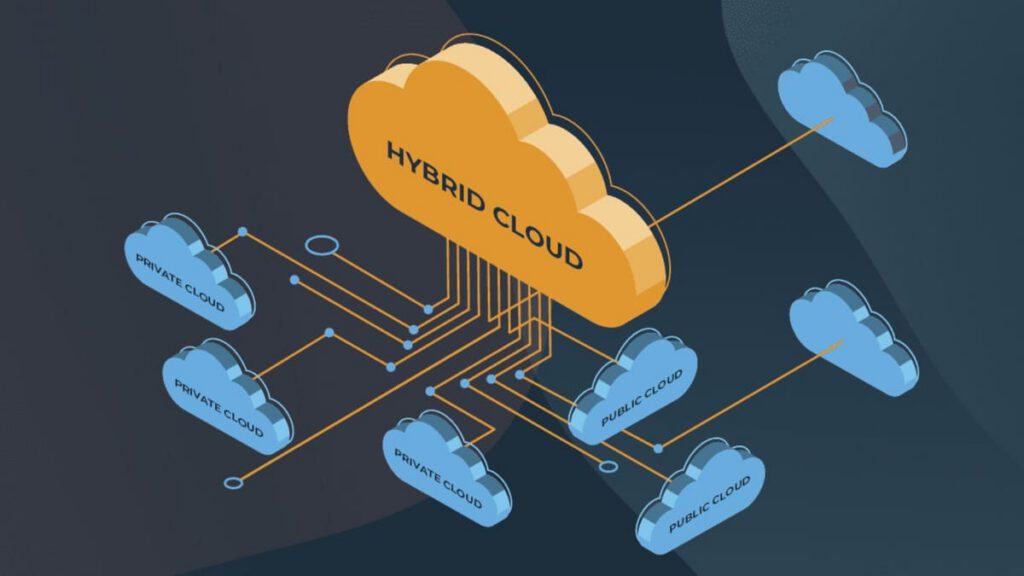
As a result, hybrid cloud architecture is increasingly being used. This architecture combines a private cloud environment, public cloud services, and on-premises infrastructure. Instead of a single model, a flexible system appears in which workload placement is determined by performance, security, and cost requirements. As a result, many organisations are now implementing hybrid architectures while working with providers of cloud solutions in Dubai to balance flexibility, cost, and performance.
What is a Hybrid Cloud Architecture?
Hybrid cloud architecture is an infrastructure model in which multiple computing environments operate as a single platform. The organization manages applications and data through workload management, distributing them between the cloud and on-premises systems.
Some cloud-native applications work exclusively in the cloud. Other systems, especially latency-sensitive workloads, may be located closer to users. As a result, a hybrid IT ecosystem is being formed, where the infrastructure is tailored to specific tasks.
For example, analytical services and machine learning workloads can be performed in the cloud. At the same time, databases with sensitive information remain in private infrastructure. This approach reduces delays, improves access control, and facilitates compliance with regulatory requirements.

Why Companies Are Reviewing Their Cloud Strategy
The Economics of Cloud Resources
The cost of cloud resources has become one of the main factors in the architecture revision. Companies have discovered that cloud infrastructure costs can grow quite quickly. Especially if there is no competent cloud cost governance.
The research shows an interesting picture. About 35% of cloud spending turns out to be inefficient. Most often, the reason is simple: incorrectly selected virtual machine sizes, excessive data storage, or forgotten computing resources.
This is why businesses increasingly rely on optimisation strategies and professional support from an IT maintenance company in Dubai to manage cloud governance and cost monitoring.
Optimising the infrastructure can significantly reduce costs. For example:
- Using reserved capacity reduces costs by 30-60%
- Interruptible computing resources reduce the cost of computing by 60-90%
- Automatic auto-scaling infrastructure reduces costs by 40-60%
Therefore, more and more companies are implementing cloud monitoring tools, conducting resource right-sizing, and regularly analysing resource usage.
Limitations of The Public Cloud
Despite the advantages of the cloud, some systems do not work well in remote data centres. This is especially true for high-bandwidth applications and real-time data processing.
Imagine a system that processes a stream of data in real time. Even a small delay can become critical. In such cases, organisations leave part of their infrastructure on-premises to reduce performance latency.
This is how a hybrid model is formed. The main services run in the cloud. However, high-frequency transaction systems or other sensitive systems may run on local servers.
Data Security and Control
In recent years, the requirements for information protection have noticeably increased. Companies are required to take into account data sovereignty, the requirements of industry standards, and the overall data protection strategy.
Therefore, infrastructure architecture is often based on the principle of separation. Sensitive data is stored in a private cloud environment or on local servers. Cloud resources are used for computing, analytics, and scaling.
The security of such an infrastructure is maintained through several key mechanisms:
- Identity and access management
- Multi-factor authentication
- Encryption and authentication
- Network security architecture
- Virtual private network environments
All these elements form a stable cybersecurity position of the organization.
Managing Workloads in a Hybrid Infrastructure
The main task of the hybrid environment is an effective workload placement strategy. The organization must determine which systems work best in the cloud and which ones work best on-premises.
Workload categorisation is performed for this purpose. Analysed:
- Performance requirements
- Data volumes
- Safety requirements
- Cost of infrastructure
After that, a resource allocation scheme is formed. Some applications use public cloud services. Others run on private infrastructure or local servers.
This allocation increases operational efficiency and allows for more precise cost control.
Automation and Modern Management Tools
Modern infrastructures are becoming more complex. Therefore, automation and monitoring tools and infrastructure orchestration systems are actively used.
A particularly important role is played by:
- Containerization technology
- Container orchestration
- Microservices architecture
- Serverless computing model
Containerisation allows you to run applications in almost any environment. The program can run on a local server, in a private cloud, or on a public cloud platform.
Cloud management platforms are used to manage the entire system. They combine infrastructure monitoring, security management, and cost control.
Infrastructure Resilience and Fault Tolerance
Another important advantage of the hybrid architecture is to increase the stability of services. Companies create infrastructure with multiple levels of protection.
Applied:
- Infrastructure redundancy
- High-availability architecture
- Distributed data storage systems
The disaster recovery strategy is used to ensure business continuity. Data is copied via data replication, and backups can be stored in different regions.
Such a system significantly enhances business continuity planning. Even with infrastructure failures, services can continue to work.
Migration Strategies to The Cloud
Lift-and-Shift
The simplest option. Applications are migrated without changes. This transition usually takes 4-8 weeks.
Replatforming
In this case, the architecture is partially upgraded. For example, databases are being transferred to managed services. This transition takes approximately 6-12 weeks.
Refactoring
The most difficult approach. Applications are completely redesigned for cloud-native applications and microservices architecture. Migration can last from 3 to 12 months.
The Growth of the Use of Cloud Technologies
The scale of cloud technology adoption continues to grow. In 2026, the global cloud computing market exceeded $830 billion. Companies with 5-200 employees are particularly actively using the cloud.
There are also important trends:
- 94% of organizations already use cloud services
- The number of cyber attacks on small businesses has increased by 67% since 2023
- The average cost of a data leak for companies with up to 500 employees exceeds 150,000 dollars.
These factors are increasing interest in hybrid infrastructure. It allows you to combine the advantages of the cloud and the control of local systems.

How Will The Corporate Infrastructure Develop?
Today, it is becoming clear that enterprise infrastructure is rarely built around a single technology. Instead, a hybrid operating model is being formed in which different types of infrastructure work together.
The cloud is used for scalable services. Local systems provide control and low latency. Private clouds help to solve security and compliance problems.
This approach makes the infrastructure more flexible. Organisations have the opportunity to manage workload mobility, optimise resources, and gradually develop their IT architecture.
The main principle remains simple. Workloads should be placed where they work most efficiently. Sometimes it’s a cloud. Sometimes it’s a local infrastructure. Increasingly, it’s a combination of them.

I write about how sites, digital tools and work processes affect real work. I am interested not in trends for trends’ sake, but in clear solutions that make the digital environment more convenient, more stable and more useful.